 Kitchen Notes
A Two-Ounce Morning Bottle, Run Through My Kitchen Like a New Recipe
Magic Mind Original is a cold shot of matcha, five vitamins and a blend, a quarter cup at a time. I cooked for thirty-four years, so I measured it, tasted it and wrote it a hundred-day test.

This is a paid advertisement. Sponsored by 10,000 Inc.
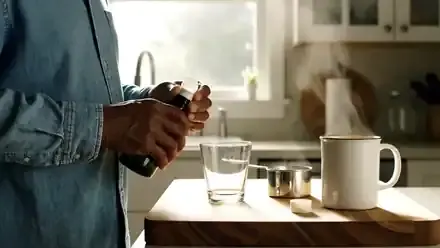
Eleven small green bottles turned up in my refrigerator door this summer, left there by my son-in-law from a box of fifteen, and every one of them holds exactly two fluid ounces.
In a kitchen that is a quarter of a cup, four tablespoons, one ordinary jigger, and I have been pouring quarter cups since before most of today's line cooks were born.
So I did what I did for twelve years in a test kitchen with every new recipe that crossed my counter.
I measured it, I tasted it, I set a plain cup of coffee beside it, and I wrote it a test that fits inside the seller's hundred-day refund window.
This page is that test, written out so you can run it in your own kitchen.
Vernon Crisp is the pen name of this desk.
Everything on this page about the bottle comes from the seller's own product page, its published label file, its terms and its public review system, all read before September 21, 2026.
The customers quoted further down are real, and their words are public on the seller's own page.
The small pictures beside them are illustrations, not the reviewers.
I cooked for a living for thirty-four years.
Twenty-two of them were on hot lines in diners and hotel kitchens, and the last twelve were in a test kitchen that wrote recipe cards for a chain of grocery stores.
A test kitchen is a strange, patient place.
Nobody in it is allowed to say a recipe works until it has been made the same way several times, by more than one pair of hands, and written down every time.
That habit never left me.
When my son-in-law Dale asked whether the little green bottles in my fridge door were worth what he paid for them, I did not have an opinion to give him.
I had a method, and in a kitchen a method is worth more than an opinion.
Dale is fifty-one and busy, and he bought the box because a friend of his swears by it.
He drank four, got called away for work, and left eleven in my fridge door with a note that said "Try them, tell me."
So I took one out, cold, and set it on the cutting board.
The first thing a cook does with any new ingredient is not taste it.
He measures it, because every recipe on earth starts with an amount.
The Rule on the Test Kitchen Wall
In the test kitchen there was a sheet of paper taped beside the walk-in cooler, yellowed and spotted with years of grease.
It had four lines on it, typed by a woman who ran the place before me, and I can still recite them.
One: measure everything, even the salt you think you know.
Two: change one thing at a time.
Three: cook it at the same hour, in the same pan, on the same burner.
Four: write it down while it is still warm, because tomorrow you will remember it better than it was.
That last line is the one people laugh at, and it is the one that matters most.
Every cook who ever lived remembers his own good dishes as better than they were, and nothing but a written note taken on the day keeps him honest.
I have come to think those four lines are the best advice ever written for anybody trying something new in the morning.
A new coffee, a new cereal, a new walk before breakfast, or a small bottle with a long list of ingredients on its back.
Most people judge a new habit on one good morning or one bad one, which is exactly how a bad cook judges a dish.
A good cook waits for the fifth plate, and he keeps notes on all five.
So this page follows the four lines in order.
First I measure the bottle in kitchen units, then I taste it, then I put a control cup beside it, and then I write the test out day by day so you can run it at your own counter.
Nowhere on this page will I tell you what the bottle will do for you, because no cook can tell you how a dish tastes in your mouth.
What I can tell you is how to find out for yourself without fooling yourself.
That turns out to be the harder job, and the more useful one.
What Came Out of the Fridge Door
The bottle is called Magic Mind Original, and it is made and sold by a company registered as 10,000 Inc., with a street address on Electric Avenue in Venice, California.
It is sold as a dietary supplement, but it is a drink, and that combination changes how you should think about almost everything else on this page.
A capsule sits in a cupboard for a year and nobody minds.
A drink is food, and food has a shelf life, a temperature, a taste and a place in the refrigerator.
The seller says plainly that the bottles are perishable and should be kept cold.
For that reason, the seller does not take the product back once it has been shipped.
Hold on to that sentence, because it shapes the refund terms, and the refund terms shape the whole test I am going to give you.
The label's own numbers, which I will go through one at a time, are short.
Twenty-five calories, a gram of fat, four grams of carbohydrate, three grams of sugar, all of it added.
Then five vitamins, each with its amount and its percentage of the day.
Then one more line, a patented blend of 1,925 milligrams, with nine names on the seller's page and no amount printed for any of them.
And one number the seller gives on the product page rather than the panel.
Fifty-five milligrams of caffeine a bottle, which the seller says comes from the matcha, the powdered green tea in the blend.
A quarter cup of cold green drink, with about half a cup of coffee's caffeine in it.
That, in one sentence, is what was standing on my cutting board.
Everything after this point is a cook finding out what those numbers mean at a kitchen counter.
Two Ounces Is Four Tablespoons
Start with the size, because the size is the first thing a cook sees and the last thing a label explains.
The front of the bottle prints two fluid ounces, sixty milliliters, and the box prints fifteen shots of two ounces each, thirty fluid ounces in all.
Two fluid ounces is a quarter of a cup.
It is four level tablespoons, twelve teaspoons, one standard jigger, or about two good swallows for a grown man.
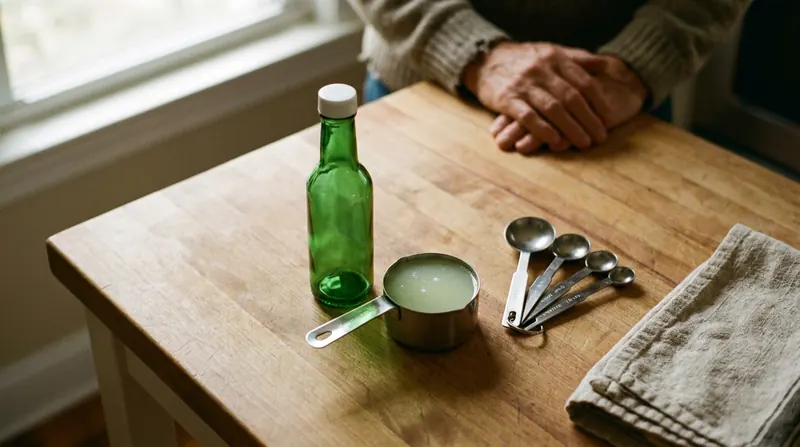
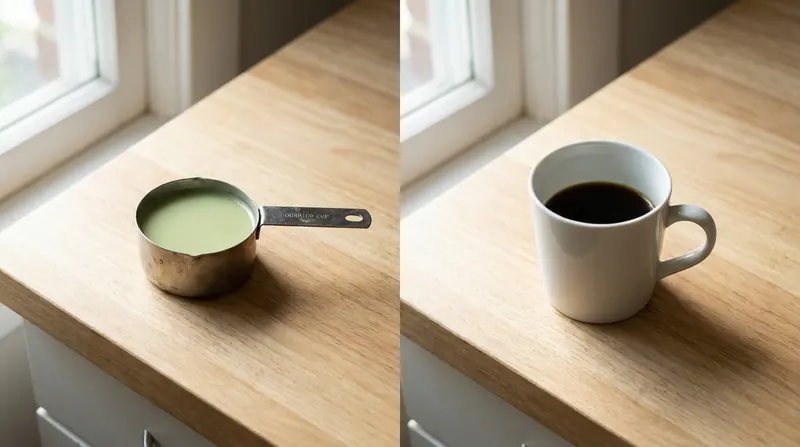
I poured one into a quarter-cup measure to check, the way I would check any supplier's portion.
It filled the measure to the rim and not a drop over, which tells you the bottling line is doing its job.
A whole box of fifteen holds thirty fluid ounces.
That is three and three-quarter cups, a little under a quart, so the entire box would fit in one ordinary pitcher with room to spare.
I mention it because size changes how you judge the rest of the numbers.
A two-ounce drink cannot carry much of anything by volume, so every milligram printed on it is doing its work in a very small glass.
Now the food numbers.
Twenty-five calories a bottle is a small number for any food, and a gram of fat is a crumb.
Four grams of carbohydrate, and three of them are sugar, and the panel says all three grams are added sugar, six percent of the day.
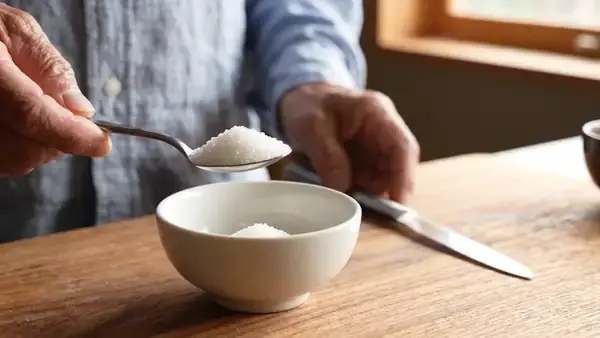
Three grams of sugar is a little less than one level teaspoon from the sugar bowl.
Why is it there at all?
Because matcha on its own tastes like a lawn after rain, and anybody who has ever cooked with bitter greens knows that a little sugar makes them eatable.
If you are a man who counts sugar, count it.
It is a small daily entry, fifteen of them to a box, and it belongs in the same column as the sugar in your coffee.
Then the caffeine, which is where the kitchen math gets interesting.
Fifty-five milligrams in two ounces works out to about twenty-seven and a half milligrams an ounce.
The Food and Drug Administration says a twelve-ounce cup of brewed coffee holds somewhere between 113 and 247 milligrams of caffeine, depending on the beans and the brewing. [1]
Divide that by twelve and ordinary brewed coffee carries roughly nine to twenty-one milligrams an ounce.
So ounce for ounce, this bottle is stronger than the coffee in your mug, and glass for glass it is much weaker.
Both halves of that sentence are true at once, and both matter.
A full twelve-ounce mug carries between two and four and a half times the caffeine of one bottle, because the mug is six times bigger.
Half a cup of brewed coffee, four ounces, works out on the same figures to somewhere between about 38 and 82 milligrams.
The bottle's 55 sits right inside that range, and you will see in a minute why that particular comparison is worth its own section.
Small glass, strong for its size, modest in total.
The five vitamins I will leave for their own section later, because they need a different kind of kitchen talk.
And the blend of 1,925 milligrams I will come to as well, because a cook has a particular objection to it that is worth hearing.
The Taste, and Why a Cook Starts There
Then I tasted it, which is the second thing a cook does and the thing a label never tells you.
It is cold, faintly sweet, grassy and slightly bitter at the back, with the thick, powdery feel that any drink made from ground tea leaf has.
It is not unpleasant to me, but I have spent my life tasting things that were not meant to be pleasant yet.
I would not call it a pleasure, and I will not pretend it tastes like orange juice.

You do not have to take my word on the taste.
One of the buyers on the seller's own review page gave the bottle five stars and then wrote, in the same breath, that it tastes pretty bad.
I like that review more than most, because it is the kind of note a cook would write.
She liked what she thought it did, she did not like the taste, and she said both things without letting one swallow the other.
Taste matters for a practical reason, and it is not about pleasure.
A morning habit that you dread is a habit you will skip, and a test with skipped days in it is not a test.
So here is what a kitchen does with a bitter, cold, small pour.
Drink it straight from the refrigerator, because cold dulls bitterness, and have a glass of plain water beside it to follow.
Take it with breakfast rather than on an empty stomach, which I will give you a second reason for when we get to one of the plants in the blend.
And do not mix it into anything, because the moment you stir it into a smoothie you have changed two things at once.
That last one is rule two on the wall, and it will come up again and again.
Taste also tells you something the label cannot, which is whether the drink is fresh.
If a bottle ever tastes sour or fizzy, or the cap is loose when you take it out, do what you would do with a carton of milk that tastes wrong and pour it out.
The tongue is the oldest quality control a kitchen has.
Half a Cup of Coffee Is the Control
In a test kitchen, nobody tests a new recipe alone on the counter.
You always make the old one beside it, the one everybody already knows, so that you are comparing two things instead of comparing one thing to a memory.
That old recipe is called the control.
Without it, a new chocolate cake is just a chocolate cake, and every chocolate cake is delicious on the day you bake it.
So what is the control for a two-ounce bottle with fifty-five milligrams of caffeine in it?
The seller's review page answered that for me, in a review with two stars on it.

With all the hype, I thought this would hit harder. For me, it was no more than a half cup of coffee or green tea. Just being honest—didn't live up to it.
Bill was disappointed, and he said so, and he deserves a hearing on that.
But look at what he actually wrote, because a cook reads it differently from a salesman.
He compared the bottle to half a cup of coffee.
And half a cup of brewed coffee is, on the Food and Drug Administration's own figures, somewhere between 38 and 82 milligrams of caffeine, with the bottle's 55 sitting in the middle. [1]
In other words, Bill's tongue and Bill's head arrived at almost exactly the number printed on the product page.
That is the most accurate review on the whole page, and it came with two stars.
It also hands you the control for your own test.
If the bottle feels like half a cup of coffee, then half a cup of coffee, drunk at the same hour, is the thing to put beside it.
Not a full mug, not nothing, and not the bottle on one day and a double espresso on the next: half a cup of plain brewed coffee, at the same hour, in the same chair.
Some men will want to use half a cup of green tea as the control instead, and Bill named that too.
It is a fair choice, since the bottle's caffeine comes from green tea leaf, but whichever cup you choose, pick one and keep it for the whole test.
The caffeine itself is not in any doubt.
The European Food Safety Authority concluded that single doses up to two hundred milligrams and daily intakes up to four hundred do not raise safety concerns for healthy adults, and that caffeine in moderate amounts increases alertness. [2]
The Food and Drug Administration cites four hundred milligrams a day, about two to three twelve-ounce cups of brewed coffee, as an amount not generally associated with negative effects in most healthy adults. [1]
The same agency notes that some people are more sensitive to caffeine than others, and says to talk to a health care provider if you take anything daily.
Fifty-five milligrams is well inside both of those figures, which is exactly what makes half a cup of coffee a fair control.
And here is the part most men forget.
The bottle's caffeine does not replace your coffee unless you let it, so if you drink the bottle and then your usual two mugs, you have added to your day rather than swapped.
Count the bottle as coffee, because to your body it is.
Fifty Milligrams and a Leaf of Tea
There is one pairing inside this bottle that has a study behind it at almost exactly the amounts on the label, and a cook would want to know about it before anything else.
It is the caffeine and one of the nine names in the blend, an amino acid from tea leaf called L-theanine.
In a placebo-controlled crossover study of 27 healthy volunteers, 50 milligrams of caffeine taken with 100 milligrams of L-theanine was followed an hour later by faster and more accurate performance on an attention-switching task, and by less distraction on a memory task at sixty and ninety minutes. [3]
Caffeine alone raised self-rated alertness at sixty minutes and accuracy on the switching task at ninety.
The bottle prints 55 milligrams of caffeine, and it does not print how much L-theanine is in the blend.
Fifty milligrams of caffeine in the study, fifty-five on the product page.
In thirty-four years of reading supplier sheets, I never saw a real product land that close to the number in a trial.
The theanine is the other half, and the bottle keeps its amount inside the blend.
One hundred milligrams would be a modest share of 1,925, so it is plausible that it is there in that amount, but plausible is not printed.
The study itself is small.
Twenty-seven people, a single dose, a crossover design where each person had both drinks on different days, and authors who worked for a tea company.
There is a second theanine study in people closer to your age.
Japanese men and women aged fifty to sixty-nine took a single dose of L-theanine and were faster on an attention task and more accurate on a working-memory task, but the published summary gives neither the amount nor the number of people, and the authors again came from a tea company. [4]
And a third, longer one.
Thirty healthy adults with an average age of forty-eight took 200 milligrams of L-theanine a day for four weeks, and their verbal-fluency and planning scores were better afterward, though against placebo the fluency gain showed only in those who started lower. [5]
Two hundred milligrams a day is twice the amount in the caffeine study and a real share of this whole blend.
I put it here because it exists, and because it is the only one of the three that ran for more than a single morning.
So the fairest thing I can say is this: the caffeine is printed, the theanine is present by name, and one small study used them together at almost these amounts.
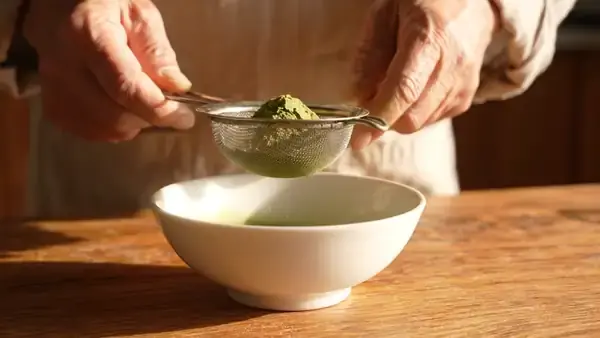
There is a cook's footnote to that pairing, and it is about the matcha.
Matcha is powdered green tea leaf, and green, black and oolong tea all come from the same plant, which carries caffeine. [6]
Tea leaf also carries theanine, which is why the pairing exists in nature before it ever existed in a bottle.
A cup of tea has always come with both halves of that study in it, in amounts that vary with the leaf and the brewing.
That does not make the bottle and a cup of tea the same thing.
It does mean that the one study with numbers near this label is, at bottom, a study of what tea has been doing in kitchens for a very long time.
Some of the oldest recipes are the ones that got measured last.
Before the objection, it is time to put the whole box on the counter, because the rest of this page is about what is inside it and how long it keeps.
A Recipe Card With No Amounts
Now the objection I promised you, and it is a cook's objection rather than a scientist's.
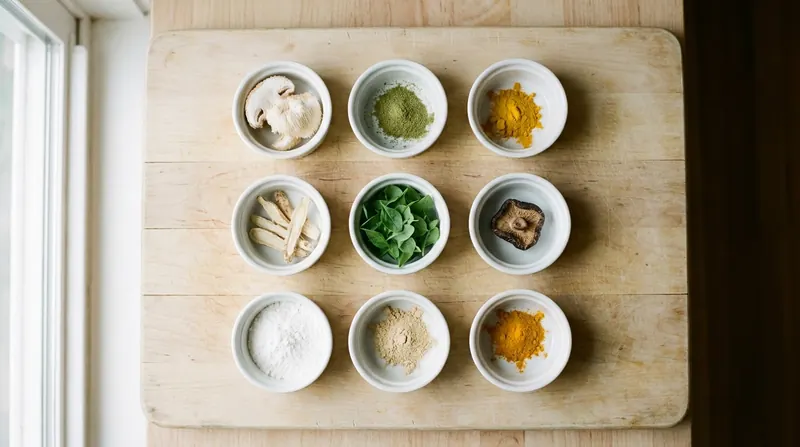
The last line on the panel is a patented blend of 1,925 milligrams, and the seller's page lists nine names inside it.
Lion's mane, bacopa monnieri, citicoline, L-theanine, ceremonial-grade matcha, rhodiola rosea, cordyceps, ashwagandha and turmeric.
Nine ingredients, one total weight, and no amount printed beside any of them.
The law allows that.
A company may print a blend as one total with the names inside it, and the usual reason given is that a recipe is a company's property and a competitor could copy it.
I understand that better than most people.
Every restaurant I ever worked in kept a few recipes in a locked drawer, and I kept a few of my own.
But here is the thing every cook knows: a recipe card with no amounts on it is not a recipe.
It is a shopping list, and two cooks handed the same shopping list will make two different dishes.
Nine names and one total tells you what went into the pot.
It does not tell you whether the lion's mane is most of it or a pinch, and those are two completely different dishes.
Here is why the amounts matter so much for this particular list.
The studies that made several of these names worth printing used specific amounts, and some of those amounts are large.
The lion's mane trial in adults over fifty used three point two grams of the mushroom a day for twelve weeks, and the people taking it scored higher on a standard mental-status test than the placebo group. [7]
Three point two grams is 3,200 milligrams, and this entire blend weighs 1,925.
The bacopa trials in healthy adults over fifty-five used three hundred milligrams a day of a standardized extract for twelve weeks. [8] [9]
The citicoline trial in adults aged fifty to eighty-five used five hundred milligrams a day for twelve weeks. [10]
I am not going to divide the blend up for you and guess, because a cook who guesses at a locked recipe is only flattering himself.
What I can tell you is that the lion's mane in its own trial would weigh more than the whole blend on its own.
And the matcha has to carry fifty-five milligrams of caffeine, so a real and unprinted share of those 1,925 milligrams is powdered tea leaf.
There is one practical thing about that list that belongs in any kitchen.
In both of the bacopa trials, the most common complaints were stomach ones: an upset stomach in the first, and more frequent stools, cramps and nausea in the second. [8] [9]
That is the second reason I gave you for taking the bottle with breakfast rather than on an empty stomach.
The amount of bacopa in the bottle is not printed, so nobody can tell you whether it is enough to matter either way.
Food in the stomach is simply the sensible way to start anything new, and every grandmother in every kitchen already knew that.
So for the test in this page, I set the blend aside.
Not because it does not matter, but because a home cook has no way to measure it, and a test is about the things you can measure.
You cannot weigh what the label will not tell you, so you weigh the morning instead.
Five Vitamins, and the One Worth a Blood Test
The five vitamin lines are the opposite of the blend.
Every one of them is printed with an amount and a percentage of the day, which is what a label is supposed to do.
Vitamin C, one hundred milligrams, one hundred and eleven percent of the Daily Value.
Vitamin D3, twenty-five micrograms, a thousand international units, one hundred and twenty-five percent.
Riboflavin, one milligram, seventy-seven percent, and niacin, eight milligrams, fifty percent.
Vitamin B12, two point four micrograms, one hundred percent.
Those percentages are measured against the Daily Values the Food and Drug Administration sets for adults. [11]
That part of the label is doing its job perfectly.
Here is the part a cook would say plainly across a counter.
In adults who are not short of these vitamins, the best evidence we have for B vitamins and everyday thinking is a null result.
A Cochrane review pooled fourteen trials covering 27,882 adults with no cognitive problems and concluded that B-vitamin supplements probably have little or no effect on overall thinking scores at any point up to five years. [12]
Most of the people in it were over sixty.
The vitamin D line goes the same way.
In a three-year trial of 2,157 adults aged seventy and over, two thousand international units of vitamin D3 a day produced no statistically significant benefit on a cognitive screening score. [13]
This bottle carries half that amount.
The numbered lines are the honest ones, and they are also the ones with the least to show for themselves in men who already eat reasonably well.
There is one exception, and I will not skip it.
Vitamin B12 is the one line on this panel where a man past sixty genuinely might be short.
The National Institutes of Health's own fact sheet says that, depending on the definition used, between three and forty-three percent of older adults living at home have low B12 in their blood. [14]
It also says the stomach of many people over sixty-five absorbs less B12 from food, and that the B12 added to supplements and fortified foods is already in the form the body can take up.
So here is my kitchen advice on B12, and it has nothing to do with this bottle.
If nobody has looked at your B12 in the last few years, ask your own clinician for the blood test.
A number from a lab is worth more than a number on a label, because it is your number.
Eggs, milk, fish and meat are the kitchen's own sources of B12, which is why the stomach's part in taking it up matters so much.
The blood test tells you which side of that line you are on, and no morning drink can tell you that.
One Change at a Time
Now back to the wall in the test kitchen, and to rule two, which is the one people break most often.
Change one thing at a time.
I once watched a young cook change the flour, the oven and the resting time on a bread recipe on the same afternoon.
The loaf came out beautifully, and nobody in that kitchen could ever tell you which of the three changes did it.
Men do exactly the same thing with their mornings.
They start a new drink the same week they start walking, cut back on the evening beer and go to bed an hour earlier, and then they credit the drink.
If you change four things and feel better, you have learned that four things are good for you.
That is not a bad outcome.
But it tells you nothing about the bottle, and the bottle is the thing you are paying for.
So for the length of the test, keep everything else in your morning the way it already is.
Same breakfast, same hour, same coffee, same walk or no walk, same evening.

The one thing you will change is the thing in the glass.
On bottle days you drink the bottle, and on control days you drink half a cup of plain coffee, at the same hour, and nothing else about your morning moves.
The coffee is the part that trips people up, so here it is plainly.
If you usually drink two mugs of coffee, keep drinking the same two mugs on both kinds of day, and put the bottle or the half cup in front of them.
That way the only difference between a bottle day and a control day is what is in the small glass.
And the caffeine difference between the two is small, because the half cup and the bottle land in the same range.
If you want to cut back on coffee, a fine idea for plenty of men, do it after the test and not during it.
Rule three belongs here too: same hour, same pan, same burner.
Take the small glass at the same time every morning, ideally with the same breakfast, because a morning at seven and a morning at ten are two different dishes.
And pick an hour that leaves the caffeine a long way from your bedtime.
Fifty-five milligrams is modest, but it is still caffeine, and a poor night will spoil the next morning's note more than anything in a bottle.
The Card on the Fridge Door
Rule four: write it down while it is still warm.
In the test kitchen we used plain white index cards, one per dish, clipped to a board above the pass.
For this test you need one index card a day, a pencil, and a magnet to hold the card on the fridge door, right beside where the bottles live.
The card goes up the moment you finish the glass, and you fill it in before lunch.
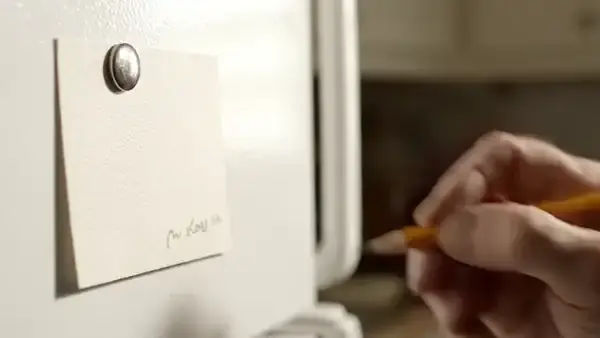
Here is what goes on each card, and it takes less than a minute.
The date, the hour you drank the small glass, and whether it was a bottle day or a control day.
- The date, the hour, and bottle or half cup
- What you ate for breakfast and how many cups of coffee you had before noon
- How the night before went, in three words or fewer
- One ordinary task from the morning and how it went: the crossword, a page of the newspaper, a phone call about something that needed doing
- Anything that did not sit right: an upset stomach, a racing feeling, a headache, a poor night afterward
- One line in your own words about the morning, written as if nobody will ever read it
That fourth line is the heart of the card, and it needs a word of explanation.
Pick one ordinary thing you do every morning and write down how it went, not how you felt about how it went.
If you do the crossword, write how many clues you finished before you put the pen down.
If you read the paper, write whether you got to the end of the long article or gave up on it.
A plain fact about your morning is worth ten adjectives about it.
"Finished the crossword, stuck on two" is a note, and "felt sharp" is a wish.
The fifth line matters just as much.
A new ingredient that does not agree with you should show up on the card on the day it happens, not three weeks later as a vague memory.
If anything on that line shows up twice, stop the test and ask your pharmacist or your own clinician about it.
That is not a failure of the test; it is the test working.
And the sixth line is for you, because some mornings are simply good or bad for reasons no card can hold.
There is one thing the card cannot do, and I want to be honest about it.
You will know which mornings are bottle mornings, because you can taste the difference, and knowing will lean on what you write.
Every cook knows this about his own dish.
You cannot taste your own cooking blind, so you do the next best thing, which is to write down plain facts and let the pile of cards talk.
One card is an opinion, and thirty cards are evidence about your own mornings.
Thirty Mornings Inside a Hundred Days
Now the calendar, which is where this bottle becomes a better test subject than most.
The seller offers a refund on a first purchase within one hundred days, and says you do not have to ship anything back.
That makes sense for a perishable drink, since a bottle that has spent four days in a delivery van is of no use to anybody.
It also means the refund covers exactly the kind of test a cook would run.
Here is the arithmetic, and it is kitchen arithmetic, nothing harder.
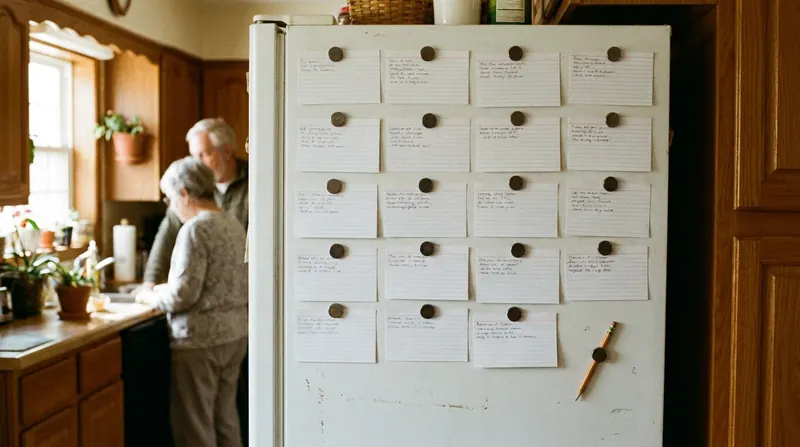
A box of fifteen is fifteen bottle mornings, and if you alternate them with fifteen control mornings, the test takes thirty days.
Why alternate, rather than drink the whole box and then do fifteen days of coffee?
Because two weeks in a row can carry anything with them: a cold, a spell of bad weather, a family visit, a stretch of poor nights.
Alternate days spread all of that evenly across both kinds of morning.
A bottle day and a control day side by side, fifteen times, is the fairest comparison a man can run in his own kitchen.
So the plan looks like this.
Day one, a bottle; day two, half a cup of coffee; day three, a bottle; and on through day thirty, with a card on the fridge every morning.
If you would rather not remember which is which, write "B" and "C" in pencil on the kitchen calendar before you start.
Odd days bottle, even days coffee, and the calendar does the remembering.
On day thirty-one you take the cards down and deal them into two piles, bottle and coffee, like a hand of cards.
Then you read each pile straight through, the way a cook reads a week of tasting notes on the same dish.
And on day thirty-one you still have seventy days left on the seller's refund window.
That is the part I like best about the arithmetic.
You are not deciding under pressure, and you are not deciding on day ninety-nine with the box long gone and only a memory to go on.
Seventy days is enough time to sleep on it, show the cards to your wife or a friend, and write to the seller if you have made up your mind.
It is also enough time to run the test a second time if the first thirty days were thrown off by a cold or a trip.
Only one purchase is covered, so a second test means a second box you pay for in full.
Now the two conditions that come with the hundred days, and both are printed plainly by the seller.
The refund applies to a first purchase, and a subscription refill that has already been shipped is a different matter.
So buy one box of fifteen, not a subscription, for the test.
A standing order that ships a second box on day thirty is exactly the kind of clause a man remembers wrongly two months later.
Write the date the box arrives on the calendar, and count a hundred days forward from it.
Circle that date in pencil too, because a deadline you can see on the kitchen wall is one you will not miss.
Fifteen bottles, fifteen half cups, thirty cards and seventy days to think.
Where Fifteen Bottles Live
Every kitchen has a place for things, and a box of fifteen cold bottles needs a place before it arrives.
The seller says to keep them refrigerated, and that is not a suggestion on a drink made of plant powders, vitamins and a little sugar.
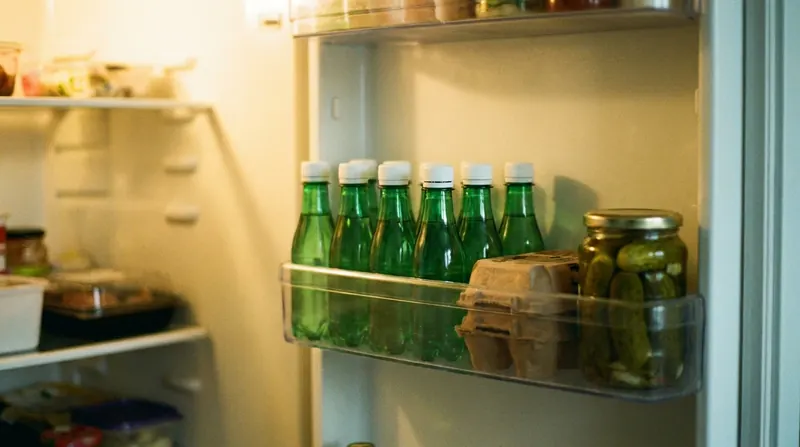
Fifteen two-ounce bottles take up most of a shelf in an ordinary refrigerator door.
If your door is already full of mustard, pickles and three kinds of hot sauce, clear a shelf before the delivery comes.
Travel is the awkward part.
A bottle that needs to stay cold is harder to take on a trip than a coffee, and the test does not travel well either.
If you have a trip planned inside the thirty days, move the start date rather than carry bottles in a cooler.
A hotel morning is a different dish from a home morning, and it would spoil your cards anyway.
Check each bottle as you take it out.
The cap should be tight, the glass unbroken, and the drink should look like the others in the row.
Anything that looks or tastes off goes down the sink, the way any cook handles anything perishable that is not right.
And keep the empties for a day or two if you like, lined up on the windowsill.
It is a small, practical way to see at a glance that the calendar and the fridge door agree.
What 274 Buyers Wrote
The seller's page carries a public review system with 274 reviews on it.
I read the ten most recent, which is what the review system showed me, and I am telling you that limit rather than implying I read them all.
Of those ten, six carried five stars, one carried three, one carried two and two carried one.
Every one of them was marked as a confirmed purchase.
A cook reads reviews the way he reads tasting notes from a line of strangers.
He does not average them; he looks for the notes that describe the same dish he is holding.
I set aside the ones that used the sales vocabulary of the category instead of the writer's own words, one about a shipping problem, and three that carried a rating and nothing written.
I set aside one more that mentioned payments to promoters without saying anything I could check.
That left four, and I kept all four, including the two-star review you already met.
Here are the other three, word for word, from the seller's own review system.

I am amazed. Best product on the market for energy.
Quick, easy start to my day. This works!

Love the results! But it tastes pretty bad…
Read them as tasting notes and they get more useful.
Andrew says energy, which is the word the caffeine line predicts and the word most people reach for first.
Ruth says quick and easy, which is a note about the habit rather than the drink.
A small cold bottle that takes two swallows is quick, and for a lot of mornings that is the whole appeal.
Julie is the cook's favorite, because she wrote two notes in one line.
She liked the results and disliked the taste, and she did not let either one cancel the other.
And Bill, with two stars, compared it to half a cup of coffee, which is the control I built the whole test around.
Four buyers, four different notes, and not one of them is a claim about memory.
That is worth noticing, because it is the right size for a review.
A buyer can tell you whether a drink woke him up, fit his morning, tasted bad or felt like half a cup of coffee.
What 274 buyers cannot tell you is what will happen at your counter, which is why the cards on your fridge door matter more than any star rating.
What I Keep on the Counter Before Any Bottle
There is a conversation I have with every man who asks me about something new for his mornings.
It comes before the bottle, it costs less than the bottle, and nobody sells any of it.
Water first.
In a Berlin study of 1,111 adults aged sixty to eighty-nine, the third of them who were measurably short of water did worse over time on a processing-speed test than the rest. [15]

A later review of eighteen studies covering 33,707 adults aged sixty and over reached the same place more cautiously, finding the link between being short of water and poorer thinking scores real but sparse. [16]
Both are observational, neither proves cause, and a glass of tap water asks nothing of your pharmacist.
A glass of water beside the small glass every morning costs nothing and belongs on every card.
It also happens to be the best chaser for a bitter green drink.
Then the pantry, over years rather than weeks.
In a Brazilian study of 10,775 adults followed for about eight years, the people who ate the most from the ultra-processed shelf slipped somewhat faster on tests of thinking and planning than those who ate the least. [17]
And in a three-year trial of 604 older adults, a group eating a Mediterranean-style pattern and a group simply eating a little less both improved their thinking scores, by about the same amount. [18]
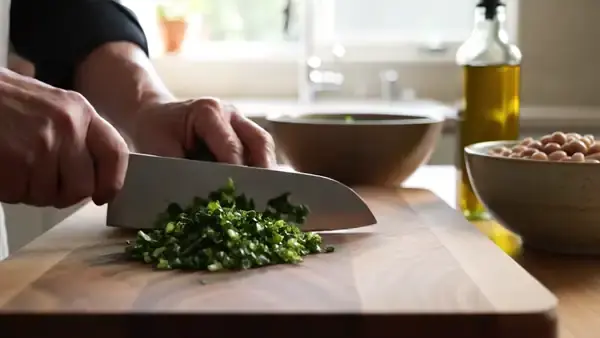
Leafy greens, beans, nuts, whole grains, olive oil, fish and berries are ordinary groceries, and any cook can make a week of good dinners out of them.
Then your hearing and your eyesight.
Straining to catch what somebody said and then not being able to repeat it looks exactly like not remembering it, from the inside and the outside.
Getting both checked is an appointment, not a purchase.
It is the single most useful hour on this list, and there is nothing to buy at the end of it.
And the B12 test from earlier, which is worth repeating because it is the one real number on this page that belongs to you. [14]
Ask your own clinician, and write the result on a card of its own.
Water, a pantry, your ears, your eyes and one blood test come first, before any bottle.
The Company on Electric Avenue, and What a Hundred Days Cover
The bottle is sold by 10,000 Inc., trading as Magic Mind, from Venice, California, and that is the only place this page will send you.
The company publishes a street address on Electric Avenue, a telephone number answered from nine to five Pacific time, and an email address.
Those are facts about who you would be dealing with, and a cook keeps them on a different card from facts about the recipe.
A supplier can answer the phone and offer good terms and still keep a recipe in a locked drawer, and this one does both.
Two small things I found in the company's own papers are worth knowing before you ever need them.
The address on the store's footer and contact page is on Electric Avenue in Venice, and the address printed in its privacy policy is a different one in San Francisco.
And the email address on the contact page ends in dot com, while the returns policy writes it ending in dot co.
Neither is sinister, since pages written at different times by different hands drift apart, but you should use the contact page when it is about money.
If you ever start a refund, write to the address on the contact page, keep the order number, and write the date on your last index card.
The bottles are also sold on other channels and in some stores, and the company runs its own subscription.
This page prints no price, because the seller sets it, it changes, and a welcome price on a first box is not the price of a second one.
Look at the price on the day you look, and look at whether the checkout is setting up a single box or a standing order.
For the test on this page, you want a single box of fifteen.
Every line printed on the panel of this bottle, in plain English, with the amount the label gives and the study behind each name, is written out in the ingredient guide linked at the foot of this page.
That guide also carries the cautions, the references in full, and the disclosures this page is required to make.
Fifteen cold mornings, a quarter cup at a time
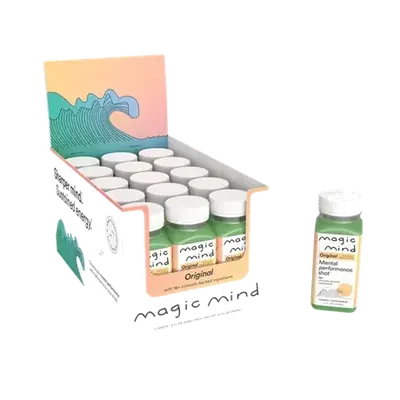
A small daily bottle of matcha, vitamins and a proprietary blend from a Venice, California company, with about half a cup of coffee's worth of caffeine.
SEE THE FIFTEEN-BOTTLE BOXSold by 10,000 Inc., Venice, California · 15 bottles of 2 fl oz, one a morning · 55 mg of caffeine a bottle · keep refrigerated · refund on a first purchase inside 100 days, nothing to ship back
What people ask me across the counter
Is this medicine?
No. It is a dietary supplement sold as a drink by 10,000 Inc. of Venice, California, and it is not meant for any medical condition.
How much is two ounces?
A quarter of a cup, four tablespoons, one jigger. A box of fifteen holds thirty fluid ounces in all.
How much caffeine is in it compared with my coffee?
55 milligrams, about half a cup of brewed coffee. A twelve-ounce mug holds 113 to 247 milligrams, according to the Food and Drug Administration. [1]
What does it taste like?
Cold, grassy, faintly sweet and a little bitter. One five-star buyer wrote that it tastes pretty bad, so drink it cold with water beside it.
Should I take it on an empty stomach?
I would take it with breakfast. The bacopa trials reported stomach complaints as the commonest side effect. [8] [9]
Should I ask anyone before I start?
Yes, if you take anything daily. Take the bottle to your pharmacist, and ask your own clinician about a B12 level. [14]
Why alternate days instead of drinking the whole box?
Because a cold, a visit or a run of poor nights can spoil two weeks in a row. Alternating spreads those evenly between both kinds of morning.
What if I do not like it?
You have one hundred days on a first purchase and nothing to ship back. Write to hello@magicmind.com or call (213) 568-6315, nine to five Pacific time.
The Whole Test on One Index Card
- Two fluid ounces a bottle, a quarter cup, fifteen to a box, kept cold, made and sold by 10,000 Inc. of Venice, California.
- Twenty-five calories and three grams of added sugar a bottle, a little less than a level teaspoon.
- 55 milligrams of caffeine: stronger than brewed coffee ounce for ounce, but a twelve-ounce mug holds two to four and a half times as much. [1]
- Half a cup of brewed coffee lands between about 38 and 82 milligrams, so it is the fair control, as a two-star buyer found by taste.
- The one pairing with a study near the label: 50 mg of caffeine with 100 mg of L-theanine in 27 volunteers; the theanine amount in the bottle is not printed. [3]
- A blend of 1,925 milligrams with nine names and no amounts, while the lion's mane trial alone used 3,200 milligrams a day. [7]
- Five printed vitamins with little to show in adults who are not short of them, [12] [13] and B12 as the one worth a blood test after sixty. [14]
- The test: one change at a time, the same hour, the same breakfast, your usual coffee kept the same on both kinds of day.
- Thirty alternating mornings, fifteen with a bottle and fifteen with half a cup of coffee, one index card on the fridge door each day.
- One box, not a subscription; the refund covers a first purchase inside one hundred days, so day thirty-one leaves seventy to decide.
- Before any of it: water, [15] [16] the pantry, [17] [18] your hearing and eyesight, and a B12 level.
What I Told My Son-in-Law
Dale came by for dinner last Sunday and asked me again whether his bottles were worth it.
I gave him the only honest answer a test cook ever gives about a dish he has not finished testing.
I told him I did not know yet, and neither did he.
He had drunk four bottles on four mornings with no card, no control and a work trip in the middle, which in my old kitchen would have been called tasting, not testing.
Then I told him what I found out at the counter, which is a smaller thing but a solid one.
It is a quarter cup of a cold, grassy drink with about half a cup of coffee's caffeine, a little sugar, five honest vitamin lines and a blend with a locked recipe.
The caffeine and one of the tea-leaf ingredients have a small study behind them at almost these amounts.
Most of the rest of the list is a shopping list without weights, and the vitamins have little to show in a man who eats reasonably well.
The terms are among the fairest I have seen on anything sold for the morning, with one hundred days on a first box and nothing to send back.
That makes it one of the few things you can test properly in your own kitchen without risking the price of the box.
So I handed him a stack of index cards, a pencil and a magnet, and told him to start over on the first of the month.
If you want a small, cold, caffeinated habit that fits in two swallows, this is an honest version of that thing.
If you are buying it for the nine names, understand that you are trusting a recipe you cannot see, and a card on your fridge door is the only way to taste it for yourself.
Buy one box, not a subscription, drink it at the same hour on alternate mornings, and put half a cup of coffee on the other mornings.
Write a card every day, deal the cards into two piles on day thirty-one, and decide with seventy days still on the clock.
That is the fairest test anybody can run on this bottle, and it is the one I would run on any new recipe.
Measure it, taste it, set the old recipe beside it, and write it down.
One box for a thirty-morning test at your own counter
A small daily bottle of matcha, vitamins and a proprietary blend from a Venice, California company, with about half a cup of coffee's worth of caffeine.
SEE THE FIFTEEN-BOTTLE BOX10,000 Inc., 1291 Electric Ave, Venice, California · (213) 568-6315, nine to five Pacific · refund on a first purchase inside 100 days, nothing to ship back · keep the bottles cold
P.S. If you remember one number from this page, remember two ounces.
It is a quarter cup, which means the bottle is small, strong for its size and modest in total, and half a cup of coffee is the fair thing to set beside it.
P.P.S. If a worry about your own memory has been with you for a year or more, speak to your own clinician before you buy anything at all.
A cold bottle in the fridge door was never going to answer a question that a proper appointment and a blood test answer in an afternoon.